Comparisons
The Best Screenshot APIs in 2026 (An Honest Comparison)
June 11, 2026 · 6 min read · Grabbit Team
Most "best screenshot API" posts are affiliate-link roundups. Ratings correlate with payout, not with what actually fits your use case. This post uses verified pricing data (June 2026) and compares on the criteria that matter for developers: billing model, per-grab cost, features, and how well the API fits automation and agent workflows.
What to look for
These are the dimensions that separate one screenshot API from another in practice:
Billing model. Monthly subscriptions reset unused credits every cycle. If your volume is spiky or seasonal, you pay for capacity you do not use. Annual flat plans and prepaid credits do not reset. For variable workloads, the billing model often matters more than the per-grab rate.
Per-grab cost. At moderate volume, rates range from $0.0002 to $0.0079 per capture. A higher per-grab rate is not always worse: some providers include features (cookie consent, selector targeting) that others charge extra for or omit entirely.
Core features. Full-page capture, custom viewport, output format (PNG/JPEG/WebP), delay_ms wait controls for JavaScript-heavy pages, and CSS selector clipping are the set you need for any non-trivial pipeline. Cookie-consent dismissal is increasingly important for EU-targeted apps.
Agent and automation support. APIs built for AI pipelines offer an MCP server or a one-line integration path. Most existing tools were designed before agent frameworks existed and require custom glue code.
How the options compare
Prices verified June 2026 from each provider's public pricing page, normalized to approximately 10,000 grabs per month. Browserless and Thum.io list a lower per-grab rate than Grabbit; the trade-offs are detailed below.
| Provider | Per grab | Billing | Included | Waste | Full page | Wait + selector | Cookie consent | Agent |
|---|---|---|---|---|---|---|---|---|
| Grabbit | $0.002 | Annual flat | 25,000/yr | None | Yes | Yes | Yes | One-line |
| ScreenshotOne | $0.0079 | Monthly | 2,000/mo | Resets | Yes | Yes | Yes | MCP |
| ScrapingBee | $0.0049 | Monthly | ~10,000/mo | Resets | Yes | Yes | No | MCP |
| Browserless | $0.0013 | Monthly | 20,000 units/mo | Resets | Yes | Yes | Yes | MCP |
| Urlbox | $0.0066 | Monthly | 2,000/mo | Resets | Yes | Yes | Yes | None |
| ApiFlash | $0.0035 | Monthly | 1,000/mo | Resets | Yes | Yes | Yes | None |
| ScreenshotMachine | ~$0.003 | Monthly | 2,500/mo | Resets | Yes | Yes | No | None |
| Thum.io | $0.0002 | Usage metered | $1–$20/mo min | Minimum | No | No | No | None |
The options explained
Grabbit is a REST endpoint: POST a URL, get back a hosted image_url. The $50/yr flat plan includes 25,000 captures that never reset. Full-page, custom viewports (320–1920 px), all three output formats, delay_ms wait, selector clipping, and cookie-consent handling are all included. An MCP server lets AI agents call it without any custom integration code.
ScreenshotOne is the most established provider, with SDK coverage across Ruby, PHP, Go, Java, C#, and more. At $0.0079/grab it is the highest rate in this table, but if your backend is not JavaScript, the maintained first-party SDKs are a genuine advantage.
Browserless has the lowest per-grab rate among full-featured providers at $0.0013. The important caveat: it is a managed headless browser service, not a simple screenshot endpoint. You connect via Puppeteer or Playwright and write your own automation scripts. More powerful than a REST API for complex workflows; more work to set up for a straightforward URL-to-image use case.
Urlbox has the longest track record and offers enterprise SLAs. At $0.0066/grab it is on the expensive side, but it is a well-maintained product for teams with strict uptime requirements.
ApiFlash and ScrapingBee are solid mid-range options. ScrapingBee uses a credit system (approximately 25 credits per grab) and lacks cookie-consent dismissal, which causes captures to be blocked by consent banners in EU-targeted apps.
Thum.io has the lowest per-grab rate ($0.0002) with a minimum monthly charge. The trade-off is a limited feature set: no full-page capture, no wait controls, no selector targeting, and no agent support. It works for simple thumbnail generation but not for production automation pipelines.
Making your first request
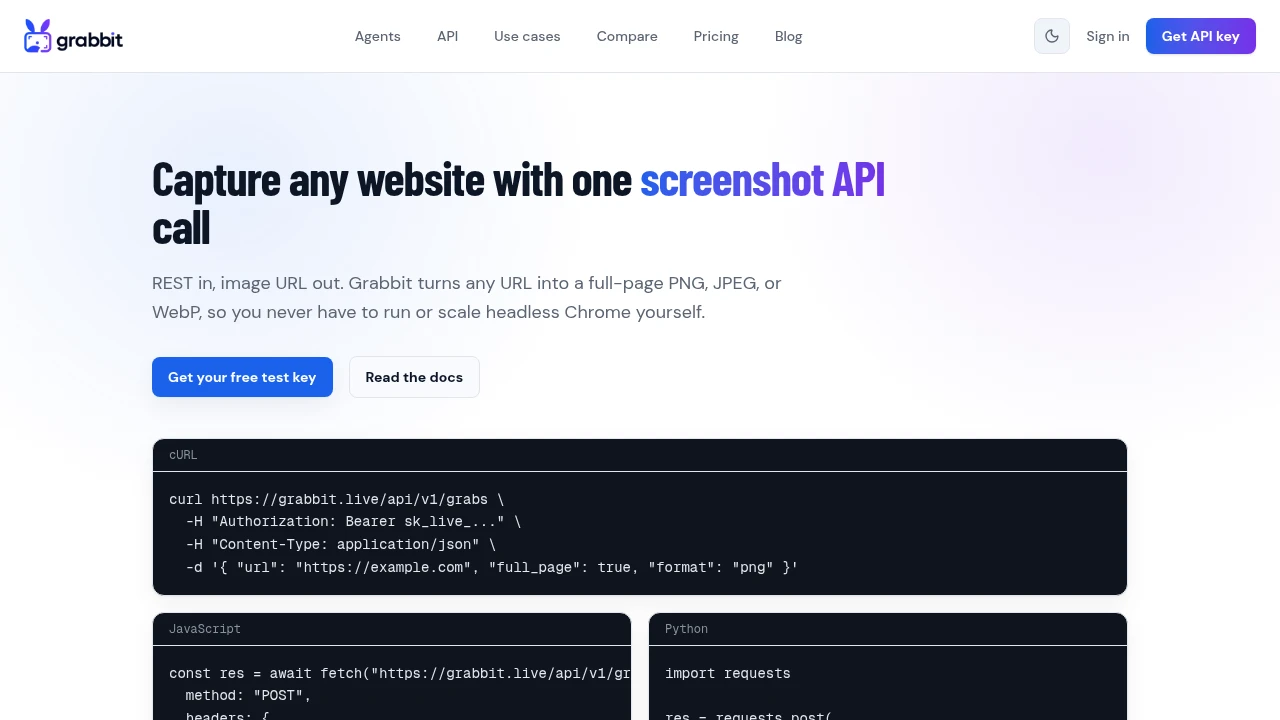
Every provider has a different auth scheme and parameter set. Here is a Grabbit request to illustrate the pattern: one endpoint, one auth header, explicit viewport:
curl https://grabbit.live/api/v1/grabs \
  -H "Authorization: Bearer sk_live_..." \
  -H "Content-Type: application/json" \
  -d '{
    "url": "https://example.com",
    "width": 1280,
    "height": 720,
    "format": "webp",
    "full_page": false
  }'
The response includes image_url (the hosted screenshot), bytes, execution_ms, and id. Add delay_ms (up to 10000) to wait for page content to finish loading, or selector to clip to a specific element. Switch to a sk_test_ key for development and CI: test captures return a placeholder image at no charge.
Billing model matters more than per-grab rate
Monthly subscription comparisons look clean in a table but obscure real cost for variable workloads. A team doing 2,000 grabs in January and 15,000 in March pays the full monthly allowance both months on a reset plan.
Prepaid credits and annual plans eliminate this: you buy a block and it covers actual usage with nothing evaporating at the end of the cycle. This makes budgeting predictable and avoids the "use it or lose it" pressure that leads teams to pad their capture volume to justify the plan.
For AI agents and automation
Most screenshot APIs were designed before agent frameworks existed. The current integration pattern is: get an API key, call the endpoint from backend code. That works, but it requires custom glue code for every agent that needs visual data.
Agent-native design means the tool registers itself as a callable function in an agent framework. An agent can capture a screenshot and get back a hosted URL to pass downstream with no extra setup. This is the pattern that makes screenshot APIs useful for research agents, monitoring pipelines, and content-generation workflows at scale.
How to choose
- Lowest per-grab rate with full features: Browserless, but you will write Playwright or Puppeteer scripts rather than calling a REST endpoint.
- Flat annual billing with no monthly waste: Grabbit.
- Widest SDK coverage for non-JS backends: ScreenshotOne.
- Enterprise SLAs and long track record: Urlbox.
- Simple thumbnails, minimal budget, no features needed: Thum.io.
- AI agents or automation pipelines: Grabbit, MCP server included.
For Grabbit's full parameter reference, authentication, and integration guides, see the screenshot API docs.
FAQ
- What is the best screenshot API in 2026?
- It depends on your use case. For flat annual pricing with no monthly-reset waste, Grabbit ($50/yr for 25,000 captures) is a strong fit. For the lowest per-grab rate with full features, Browserless ($0.0013/grab) has an edge but requires Puppeteer or Playwright scripts. For the widest language SDK coverage, ScreenshotOne is well-maintained. Match the API to how you actually use it.
- Is there a free screenshot API?
- Most screenshot APIs include a free test mode or trial credits. Grabbit gives every account a test key that returns a placeholder image at no charge, useful for development and CI. ApiFlash and several others also offer free tiers. Free tiers are typically limited to a few hundred captures per month.
- How much does a screenshot API cost?
- At around 10,000 captures per month, per-grab rates range from $0.0002 (Thum.io, limited features) to $0.0079 (ScreenshotOne). Grabbit is $50/yr flat for 25,000 captures ($0.002 each) with no monthly resets. Billing model often matters more than the headline rate for variable workloads.
- What is the difference between a screenshot API and running Puppeteer yourself?
- Puppeteer and Playwright run on your own servers: you manage browsers, scaling, maintenance, and compute costs. A screenshot API handles all of that. One HTTP request returns a hosted image URL. APIs are faster to integrate and require no infrastructure for occasional captures or automation pipelines that cannot run headless Chrome in CI.
- What features should a screenshot API have?
- Full-page capture, custom viewport width (320-1920 pixels), output format (PNG, JPEG, WebP), wait controls for JavaScript-heavy pages, and CSS selector clipping are the core set. For pipelines in the EU, cookie-consent dismissal matters. For AI and agent workflows, an MCP server or one-line integration path is increasingly important.
Capture any website with one API call
Get a free test key and capture your first screenshot in two minutes.
Written by
Grabbit Team
Screenshots as a service
The team behind Grabbit, the screenshot API for developers and AI agents. We write about web capture, rendering, and automating screenshots at scale.
Keep reading
How to Take a Full-Page Screenshot (Every Method That Works in 2026)
How to take a full-page screenshot on Chrome, Firefox, Edge, Windows, Mac, iPhone, and Android, plus how to capture full pages automatically with an API.
Jun 10, 2026 · 4 min read
Visual Regression Testing: A Practical Guide for 2026
What visual regression testing is, how the baseline-and-diff workflow works, the best tools, and how consistent screenshots keep your visual tests from going flaky.
Jun 11, 2026 · 4 min read